Saturday, September 23, 2017

MedHacks 2017

Robert and I applied to a bunch of hackathons, and recently went to MedHacks which is located in Baltimore at Johns Hopkins. I've had a negative impression of Baltimore because of its bad coverage due to riots, therefore I was pleasantly surprised to find that Baltimore is sort-of a historical location, and many places resembling remarkably like Boston. Nonetheless, when we took a quick stroll through Baltimore's streets in the daytime, we saw a sizable homeless population, which is really unfortunate.

At MedHacks, Robert and I worked really hard to pull off an Android app that lets you take pictures of pill prescriptions and reads its directions to insert them into Google Calendar. It was the first time we ever pulled off a mobile app for a hackathon and we were incredibly proud that it worked, since we had to do some complex shit like using tesseract to grab text from the picture, using nlp to autocorrect the text, and building a websocket to transfer information from the Android client to the server (which included using base64 encoding to transfer pictures as text), not to mention building the Android app itself.

It turns out that MedHacks is a pitching competition without any expectations for a working demo; the winning projects were very disappointing, and we were very disappointed with the way the hackathon was run. For example, MedHacks literally used Google Sheets for their judging system (lol!), and they conveniently forgot to list our project in the spreadsheet for judges. As a result, we only got 1 judge (out of the 3 required). We kept nagging them about this, so in a direct attempt to appease us rather than solve the problem, two MedHacks organizers became our 2nd and 3rd judge.

One corporate sponsor from Elsevier who was a second round judge (didn't qualify for our category) really loved our project. He said our project was his favorite and to quote him, "live blogged the shit" out of it, which you can find here here. A highlight from the conversation was when he asked us if we knew what ScienceDirect was. We said, "no." He then asked us if we knew what Sci-Hub is. We enthusiastically said, "YEAH." Then he was like, "Yeah we sue the shit out of them!" The Elsevier guy was really nice and offered us a job, which Robert and I found incredibly amusing.

Another funny moment was because MedHacks didn't host "hackers", we had to bring sleeping bags or make do with sleeping on the ground. Robert and I found a nice lounge on the 8th story of the building that the hackathon was hosted in, and Robert got the brilliant idea to take the single person couches, and turn them over so that with 6 of them, we could make a bed. The first night we made the bed, we didn't disassemble it. When we came back to sleep in our bed again the next night, we found that another guy had taken refuge in it.

As a result, we went to the 10th story and replicated the bed. Later that night, when we are just able to fall asleep, we heard a bunch of people walk through, complaining that the sleeping room was full, see our bed and exclaim, "Why didn't we think of that?". Robert and I got a kick out of this, commenting that it takes a sprinkle of East Campus irreverence for us to come up with our idea and have such disregard for social norms to actually implement it. Because of our nice makeshift beds, we actually slept pretty well at MedHacks.

To end this post, I guess I'll share some of the nice pictures that I took of Baltimore and Johns Hopkins:



Friday, August 11, 2017

A Tribute to my Piano Teacher: Ms. Ruo Balko

Today I was listening to the Grieg Holberg Suite during my internship, played by Dr. Hastings, who passed away last year. Dr. Hastings was my piano professor when I went to the FSU piano institute four years ago. Listening to the Holberg Suite made me feel very sentimental, and I suddenly started crying. Dr. Hastings had a reputation for being hard on his students because he pushed them to be the best that they could be. I loved Dr. Hastings; he was the best, and being reminded of Dr. Hastings reminded me of my piano teacher who had pushed me to meet him in the first place, who has by far made the biggest impact on my life yet: Ms. Ruo Balko.

Ms. Balko is the reason I went to the magnet arts schools (BAK & Dreyfoos) for middle and high school, and music festivals like FSU, Eastern Music Festival, and Southeastern Piano Festival. Ms. Balko has not only been my piano teacher, but also my mentor in life. I remember when she used to live in Village Walk, the community across from Olympia where I lived. Our "45 min." piano lessons would start at 8:30 PM and often extend until 11:30 PM, sometimes even midnight while she shared her insights on life and music.

Ms. Balko cared about her students to the point of obsession. She was constantly trying to come up with creative ways of inspiring them to practice more, researching music opportunities, and modifying her teaching technique. She was both a teacher and an avid student, and loved her profession, music, and her students beyond anyone I've ever met. Her students consistently won piano competitions, but more importantly, loved music as an extension of Ms. Balko's dedication to music and her love for her students.

Ms. Balko was the first person in my life who truly pushed me to become the best that I could be, who gave me confidence to pursue impossible things by encouraging me to tackle pieces like Chopin Sonata no.2 and Prokofiev's 3rd Piano Sonata when I wasn't yet ready for them. I remember when I wanted to play the Prokofiev's 2nd piano concerto, a piece that other professors at piano festivals thought I was crazy for undertaking. Ms. Balko, in contrast, embraced the challenge and supported me. She's the reason that I was able to perform the concerto at Eastern Music Festival with the Eastern Philharmonic, an experience that I remember fondly to this day as the highlight of my high school piano adventures.

Ms. Balko influenced my mentality in life forever. She taught me how to love deeply through the example she set herself; to never give up, to be uncompromising when pursing what I want and love; to never fear difficult problems, to instead search for them and tackle them with conviction; to remember that anything, anything in the world, can be learned through time and hard work. I respect the teaching profession immensely, which exists solely for the betterment of the next generation: a very noble goal. I respect Ms. Balko even more for sizing up her role in society, and for being a teacher who cared. Ms. Balko inspired students like me to be the best that they could be, and I would not be where I am today if not for her. For that, I am immensely grateful.

Monday, August 7, 2017

Finding your Utility Function, a Discussion on Existentialism

As a preface, this essay reflects my beliefs and opinions at the moment, which I felt would be interesting to capture for future references. I want to emphasize that my beliefs change over time and that I don't want to impose anything on you; feel free to form your own opinions.

I found this paragraph from Vitalik Buterin's personal website especially interesting:
In late 2011, I participated in a high school programming competition where players program the code for a team of simulated robots that then fight each other. I won third place. Someone asked me: what was my strategy? Others gave command-and-control strategies such as "I went for the center". I simply replied "I gave each agent a utility function and let them independently act to maximize their own objectives". That moment would inform my political beliefs for years to come.
Although thinking about life in terms of maximizing utility is just another mask for expressing existentialism, a topic already discussed in abundance, Vitalik's paragraph resonated with me because it helped me think about the meaning of life in an impersonal way.

It's very tempting to compare ourselves against each other, and for society to measure individual success on a standardized ruler. Last semester, there was a period when my friends were getting higher grades on tests while studying less than I was, and simultaneously having enough time to work on cool personal projects. I felt really stupid and my self esteem took a hit.

A couple things helped me escape my unhealthy thoughts. I finally accepted that it was not possible, nor worthwhile, to aim for straight As at MIT, which allowed me to put in less effort into my classes and instead focus on more meaningful pursuits. Another breakthrough, which ironically helped me do much better on tests, was learning how to freakin' stop worrying about things.

Unexpectedly, I discovered how to stop worrying while working on a solution in Google foobar using Dijkstra's algorithm. Dijkstra's algorithm allows you to find the shortest path from a starting node to a target node through evaluating weights to decide on the next node to visit. The idea that Dijkstra's algorithm guarantees that you find the shortest path to a goal helped me internalize the mindset that everything will be alright. Sure, this confidence is unfounded, but it helped me learn how to stop worrying about my goals, and instead focus on the most productive thing to do in the present.

We learn best when we are able to receive feedback for our actions. In the absence of a more abstract goal, feedback can be social validation or money, or anything that fulfills a person's basic needs (see Maslow's hierarchy of needs). I admit that I am incredibly privileged because I was born into a circumstance that has allowed me to focus on more abstract goals. Nonetheless, in order for the analogy of Dijkstra's algorithm to life to work correctly, we need to have a pre-prescribed goal and a clear way of evaluating our path to it.

Given that you are like me, which is privileged as fuck, this is where values come into play. I interpret values as guidelines that people live by. Because "values" sounds too passive to me, I really benefited from interpreting life as a utility function instead. I want to emphasize that seeing life as a utility function is different from adopting values because a utility function means that you are actively trying to maximize your utility, and constantly gauging whether or not your actions are productive in this context.

For example, the utilities that I'm trying to maximize at the moment are to work on interesting problems and make a positive impact on the world, whereas Richard Feynman's probably were to learn as much about the world as possible and to be happy. These are very different motivations and it makes sense that we would approach life differently.

Understanding that everyone's utility functions are different has not only helped me understand people I care about in a deeper way, but also learn how to stop judging people based on my own metrics. Everyone has different motivations in life, and as long as they're not hurting anyone else, that's okay. Nonetheless, I enjoy interacting with people who have evaluated their utility functions at all because it means they've created meaning in their lives, they're more likely to be independent thinkers, and they're more likely to be active in their lives.

In summary, I've recently started to think of life as a utility function while using Dijkstra's algorithm to justify that I will reach my goals in the end, given I am focused on using my time as productively as possible in the present. I really enjoy thinking about these more abstract ideas in the context of computer science concepts. It shows that the humanities and sciences are really more similar than popular perception likes to think.

Saturday, July 29, 2017

July 2017 Updates

This month was exciting in a couple of ways.

hackernews-newsfeed made the front of page of Hacker News and the Github repository has over 300 stars. It was my first project that went viral on the internet and I find the stars to lines of code ratio absolutely hilarious, since my script for the chrome extension barely contains 60 lines of code. I guess creating something that people actually want is important, and it helps that I wrote hackernews-newsfeed because I wanted it for myself above all else.

My friends and I also started working on a project that has prompted me to learn server-side, full-stack web dev, which includes Node.js, MongoDB, and Express. This has been interesting because I'm used to writing static websites with HTML and CSS exclusively. And at HackBrown this past February, the webapp that we made in node was pure trash with APIs just stapled together, so it's nice to learn good practices from the ground up.

Work-wise, I learned a lot from having lunch with some of Dell's older employees in the the group concerned with learning about new technologies. Some of the more interesting ideas I've learned is how because the Von Neumann memory bottleneck is preventing further increases in CPU processing speed, it's likely that the conventional CPU architecture will be challenged in my lifetime. For my project, I discovered that the deep learning load wasn't being allocated evenly between the GPUs in my server box, so now I'm learning parallel programming, specifically how to use a Message Passing Interface (MPI) library for C++.

I've been very interested in cryptocurrencies recently, and find the concept of smart contracts for Ethereum absolutely fascinating. I enjoy listening to Vitalik Buterin explain concepts on YouTube and reading his Medium blogs, and I messed around with writing contracts in Solidity. I am optimistic that digital currencies will be more widespread in our lifetime, but they face setbacks such as eliminating overhead for non-technical users, and more importantly, security. This month has been particular interesting with the $32M Parity wallet Ethereum heist since the vulnerability was a pretty low-level coding mistake. Now I understand why formal verification has become such a buzzword in the crypto community and I am excited to dabble in it when MIT starts.

I also experimented with mining digital currencies for the kicks and giggles, since MIT has free electricity and Robert and I have tons of Raspberry Pis and at least four computers lying idle, one of which has an i5 Intel processor. I joined a mining pool using my ThinkPad with an i7 Intel processor since my hash rate is way too low. My computer was mining Monero on 4 CPUs and it was getting pretty hot so I stopped mining after a while, but based on my calculations, I would make at most 50 cents a day. SO NOT WORTH IT.

I am very interested in the idea of passive income, especially after making some profit off of a bot I wrote in May, but which I discontinued because it wasn't ethical and I was mostly experimenting as a proof of concept. I've been dabbling with traditional investments in index funds such as Vanguard S&P 500 (VOO), but I wonder if there are other, cooler ways. I hope that if I keep an open mind, when an opportunity comes up, I will be able to see it.

In other news, I've been pretty unhappy this summer. I don't have a car here so my movements are pretty limited. Although I've been fortunate enough to make many friends here, whom I love dearly, I feel lonely in spirit. Every night, I look forward to video chatting with Robert to share thoughts and discuss ideas with him that no one else around me cares about. I underestimated the importance of being in a stimulating environment; Texas is not one of them, and I'm looking forward to going back to MIT in the fall.

Based on my recent observations, I've realized that my absolute BIGGEST pet peeve is bullshit. I enjoy interacting with people that come clean with what they're thinking and feeling, and who ask questions if they don't understand something. I don't like it when people feel a need to play up an image. Also, I can't stand busy work because my time is much too valuable. Realizing that minimizing bullshit and irrelevance in general is very important to me has shaped my values and my dreams. I can't imagine working for a place like Dell for the rest of my life, and the contempt for selling your soul to the corporate world is really resonating with me.

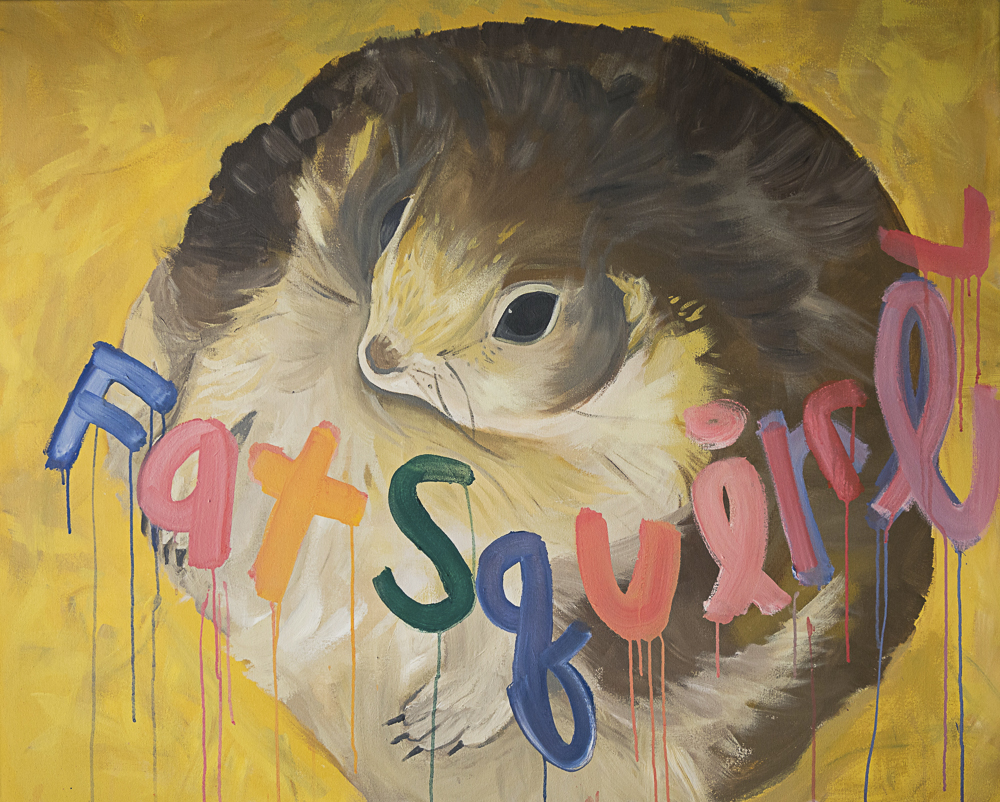
I should end this post on a positive note so I'm sharing one of James Franco's paintings, which by the way, are absolutely HILARIOUS.

Saturday, July 22, 2017

A Sentimental Reflection on How I Love My Computer

I remember coming to MIT with an HP computer that was falling apart at the hinge and restarted every couple hours for Windows 10 updates. I bought my HP computer for a little over $600 in 2014. Back then, I didn't know anything about computers so I picked my computer based on its beats speakers and the light up keyboard (lol!). For a $600 computer, the HP computer was a rip off.

One of my first decisions made at MIT was to buy a new laptop and switch to Linux. There were three computers I was seriously considering: a Dell XPS 13, a MacBook Pro, and a Lenovo ThinkPad. I was hard-set on using Linux and wanted a computer that lets you make changes to it, so the MacBook Pro was out. But it was only after a friend showed me his ThinkPad T460 that I made the decision to buy it. My friend helped me order his identical computer online, and other parts like SSD and RAM so that I could upgrade my ThinkPad's hardware by myself.

I've since fallen in love with my computer. I can't imagine life without it. I love the sound of the keyboard clicking when I type, the clicking after touch that reminds me of the after touch on grand pianos. I love the layout of the keyboard and how I can mouse click with my left hand thumb, so that I can click without moving my hand away from the standard keyboard position.

Most importantly, I love my computer because it does what I want it to do. Since switching to Ubuntu (a Linux distro), I've been able to understand the abstract architecture of my computer's file systems, and learn commands that let me do things I could never imagine possible on my old Windows HP. More importantly, when things broke, I could figure out why logically, instead of following instructions mindlessly like I used to for the Windows black-box. Although I am pretty familiar with Shell and Linux file systems by now, I am looking forward to learning even more about my computer, so that I can make more changes. Something tells me that I want to learn more C.

I find it really interesting that on my laptop keyboard for keys I've used a lot, the key's original surface has been rubbed off so that a glossy surface shows. This is interesting because I've been able to analyze how I like to use my keyboard. It looks like keys "a e d r t h n i" are used the most often, as well as the backspace, enter, space bar, ctrl, and shift. It also looks like I like to press the space bar with the thumb of my right hand, and the shift and ctrl key with my left hand pinky. Seeing the glossy surfaces makes me proud because it makes me feel that I'm getting value out of my computer.

I don't think I would be able to live without my computer anymore. Anytime I have free time, I whip out my ThinkPad, whether to read or to code. It feels as if my computer has become a part of me, to the point that when I use my work laptop: a Dell computer that runs Windows 10 Enterprise and has so many restrictions that the only thing I can really do is surf the web and answer emails, that lacks the clicking after touch on its keyboard and my added short cuts that I've grown used to using, I feel as if I've been placed into a cage too small to stretch in, and stripped of my identity.

It also makes me appreciate my ThinkPad so much more, the computer that I understand and understands me, who listens to me, who helps me work and learn, the computer that supports me as I further improve my knowledge about computers.

Tuesday, July 4, 2017

June 2017 Updates

I've recently started working at Dell. My official title is "Systems Engineering Intern", but I am basically doing benchmarking on server setups with machine learning algorithms. The pace of working at a large company is much slower than it is at MIT, and the work is easier. Therefore, I've been spending a lot of my free time reading about anything remotely cs related, and as a result I've improved my knowledge of the field.

So what have I been reading? I discovered the morning paper, a blog that summarizes cs papers. I also follow hacker news when I'm sick of reading about technical things. Also I forked the coding-interview-university github repo and have been following links of whatever interests me. While doing all this, I look up concepts I don't understand and spiral from there.

One thing I've realized from work is that I'm not as interested in machine learning as I thought I was. It's such a black box and it takes so long to train. I don't feel like I have any control over what's going on. Not to mention in its current state machine learning is not artificial intelligence; it's data science. On the other hand, readings about the stalling development of Intel processors, container ecosystems, and cloud computing have inspired an interest in distributed computing. With hardware speed advancements slowing down, it's likely there will be a lot of progress in this domain in the next five years.

For the last couple of days, I've been working on a Google chrome extension that replaces my Facebook newsfeed with Hacker News. I'm sick and tired of Facebook. I've tried removing the app on my phone multiple times, but I'm so addicted to the site that blocking it is counterproductive. Therefore, I decided to replace it with an equally addicting, but less stupid site: Hacker News. I just published the extension on the chrome store, which you can download here.

Something interesting about workflow is how fast time would fly by when I am stuck while working on the extension. Instead, I realized that if I walk away and go do something else, somehow I would magically know the solution when I come back. It's like my subconscious works in the background to figure things out, and I will try this *spacing time out around thinking* technique more during the school year when I work on hard problems.

In other business, I've began working out because I'm frail and I'm starting to see cellulite on my legs. I began with running a mile a day for around a week, and gradually added more exercises. Yesterday, I spent an hour at the gym and ran one mile, did 80 squats, 200 hip thrusts, and 60 10 second leg raises, not to mention various other stretches that I was too lazy to quantity. Exercising has given me a lot more energy and my legs are getting stronger.

Also, I've been partaking in various events around Austin with a group of friends. Last week, I went to a poetry slam at a bar, which was interesting because I heard issues including rape, racism, and abortion spoken through real people. The experience really legitimized these issues for me. Among other things I've done, which includes kayaking, dinner on a lake, blues on the green, and seeing the Texas capitol, I went camping with my roommate and another friend at the Enchanted Rock State Natural Area. We spent the day hiking and gazed at stars at night. It was a very surreal experience.

I guess I will end this post with some pictures that I took. Enjoy!


Dell main headquarters in Round Rock, TX

view from our campground

view from hiking

kayaking on the Colorado River in downtown Austin

view of Colorado River from shore

dinner at the Oasis overlooking this view

view at the Oasis at sunset


Saturday, May 6, 2017

Google's Secret Recruitment Portal, SIPB, Hyades: A Network Load Balancer, and more...

I haven't written a blog post in a while so I figured I would take a moment to document my life during this period.

A couple days ago, I stumbled upon a mysterious popup when I was googling terms related Google's computing infrastructure. "You're speaking our language. Up for a challenge?" it said. I was both spooked and excited. It turns out I had entered the world of Foobar, Google's secret hiring portal.


Foobar posts a series of coding challenges. Apparently when you get past level 3 or 4, it asks for your contact information and recruiter reaches out to you to offer an interview. After listening around, I found out that someone I knew got past level 5, was contacted by a recruited, and reached the project matching phase of Google recruitment process. I decided to give Foobar a shot... and it turned out to be a lot of fun.

I'm currently on level 3 and I have one challenge left to pass before advancing to level 4. Most of the challenges were fairly straightforward but I really struggled on one that asked for an implementation of Dijkstra's algorithm with a twist... something I had never seen before. Although I passed it eventually, I had to learn a lot along the way.

Foobar really highlights the art of writing good, clean code. Through doing some of the earlier challenges, I learned about Generators, and more python syntax such as "yield", "continue" (in a for loop), and "enumerate" (which can replace the ugly "for i in range(len(x)):"). I also had to consider complexity when one of my initial solutions for a challenge didn't pass because Foobar put a time limit on runtime.

Here are some screenshots of Foobar:


Outside of Foobar, I received SIPB membership a month ago for organizing SIPB CPW. SIPB is the MIT Student Information Processing Board that a friend on hall introduced me to at the beginning of the year. It was MIT's first computing club established in 1969 and is the home base for many computing enthusiasts. The SIPB office has since become a hackerspace where people come together to work together on projects.

As part of SIPB, I am currently working on Hyades, a network load balancer, with a group of other SIPBians. Hyades is our attempt at creating an open-source version of Google's Maglev [1] to use for MIT's services and beyond. Our team has been meeting every Saturday to work on it and I've learned about what it means to organize and work on a large scale technical project in a group dynamic.

The most difficult part of Hyades is understanding design choices based almost solely on information gathered from the paper Google released in 2016 describing Maglev. Equally hard is breaking these design choices down into modules that our team members can each work on to piece together the project as a whole in the end. I've learned a lot, not only about the nitty gritty about how networking works, such as how to design and implement a load balancer health checker, but also how to design and break down large technical projects into pieces that a team can work on collaboratively.

Overall, I'm having a really great time at MIT and I'm looking forward to working on machine learning at Dell this summer. Since it's getting close to the end of the year, I will probably write an article sometime later detailing my reflections on my first year at MIT.

When bogged down by psets and grades, sometimes I forget how lucky I am to be at the greatest technical institute in the world, how lucky I am to able experience on a daily basis an institute famous enough to attract regular tourists. Life is good.

[1] https://research.google.com/pubs/pub44824.html